Your visual field is the area you can perceive while keeping your gaze in one place. Central vision provides detailed information about what you are looking at, while surrounding vision helps you notice movement, navigate spaces and remain aware of objects to the side. Different parts of the retina and visual pathway contribute to this broad picture.
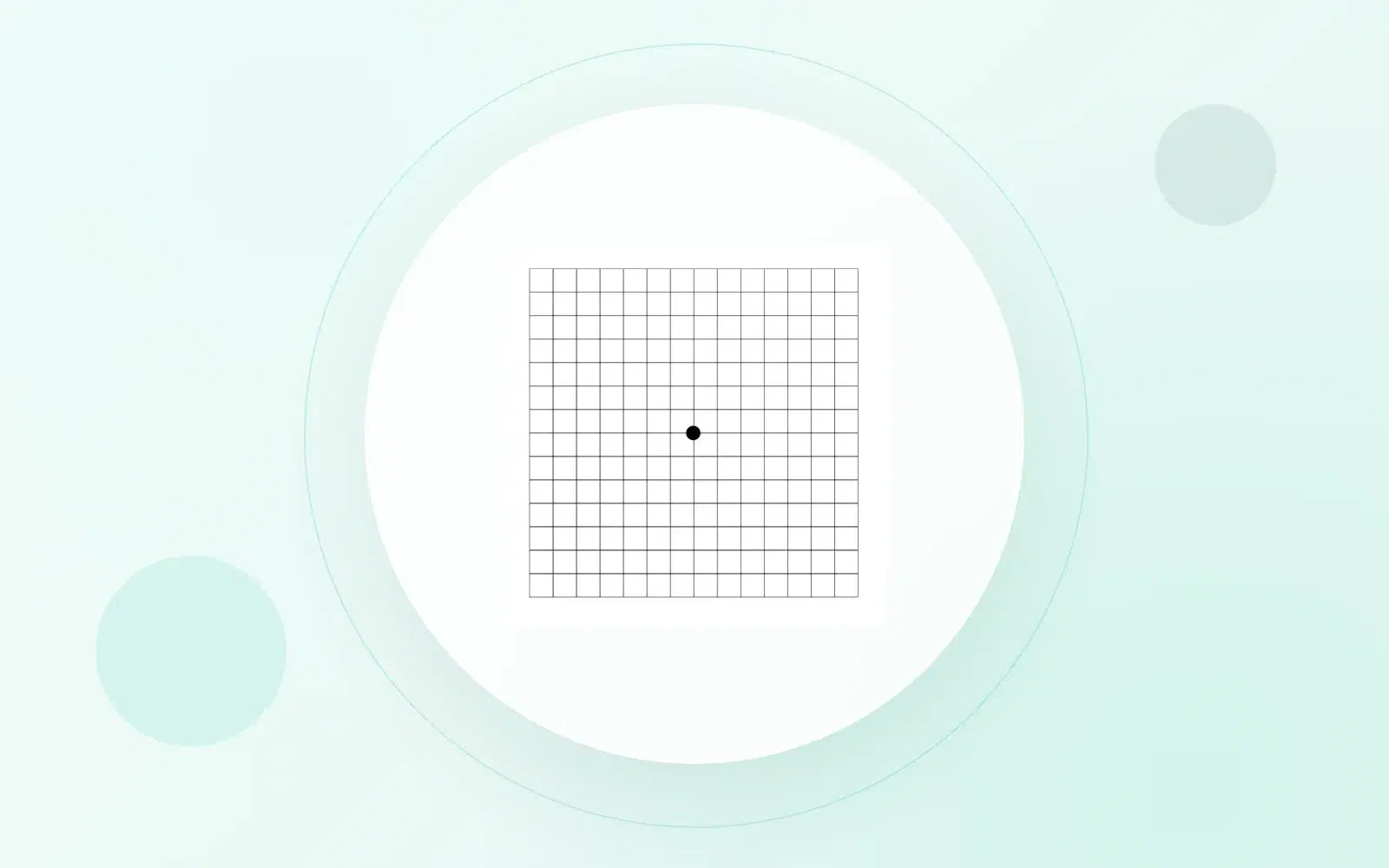
Eye Care's Watch the dot activity asks you to cover one eye, hold the phone at roughly half an arm's length and focus on the central dot of a grid. You then consider whether the lines and squares look even and regular. This is a simple observation task. It is not the same as clinical perimetry, which tests many locations under standardised conditions.
Why fixation matters
The activity only makes sense when your gaze stays on the centre. Looking directly at a suspicious area moves that area into central vision and changes the task. Blink normally, resist chasing the lines with your eyes and pause if you lose the central point. Complete the check for each eye separately because one eye can compensate for the other when both are open.
Prepare the screen and your position
- Use your usual reading correction if that is how you normally view the phone.
- Choose even lighting and avoid glare, reflections or a very dark room.
- Hold the device at the distance requested by the app and keep it still.
- Cover the other eye gently without pressing on the eyelid.
- Keep looking at the centre while noticing the grid as a whole.
A small phone screen shows only a limited region, and its size differs between devices. The pattern can also be affected by screen damage, display scaling and viewing distance. For those reasons, a reassuring app result cannot rule out a visual-field defect or a problem elsewhere in the eye or visual pathway.
What professional visual-field testing does
During a professional field test, stimuli are presented in different places while you maintain fixation. The responses create a map of sensitivity across the tested area. Clinicians evaluate the result together with reliability measures, eye pressure, optic-nerve appearance, retinal findings and your medical history. The National Eye Institute includes visual-field assessment among the components that may form part of a comprehensive dilated examination.
A grid on a phone is an awareness tool. It cannot reproduce the extent, calibration or interpretation of a clinical visual-field test.
Changes that deserve attention
Arrange an eye examination if lines repeatedly appear missing, distorted or irregular, if one eye differs from the other, or if you often miss objects on one side. Mention whether the change is stable, gradual or linked with headaches or other symptoms. A professional can decide which tests are appropriate rather than relying on one pattern.
A sudden shadow, curtain, new blank area, flashes, many new floaters or abrupt loss of side vision can be urgent. Seek immediate medical advice instead of repeating the app check. Sudden field changes may have causes where early assessment matters.
Use repeat checks carefully
If a clinician has already asked you to monitor a grid at home, follow their instructions about distance, correction and frequency. Otherwise, avoid turning the activity into constant reassurance-seeking. Occasional checks under consistent conditions can help you notice a change, but regular professional care remains important because some eye diseases produce few early symptoms.
If you notice something unusual, write down which eye was tested, where in the grid the change appeared and whether it looked the same on a later check. A simple sketch of the grid with the affected area marked can be surprisingly helpful during an appointment, and it takes less than a minute to make.
Everyday clues can be informative too. Bumping into door frames on one side, missing words at the start or end of a line, or being surprised by people approaching from the side are worth mentioning. None of these proves a field problem, but together with a professional examination they help build a clearer picture. Try to note when each clue first appeared and whether it has changed.