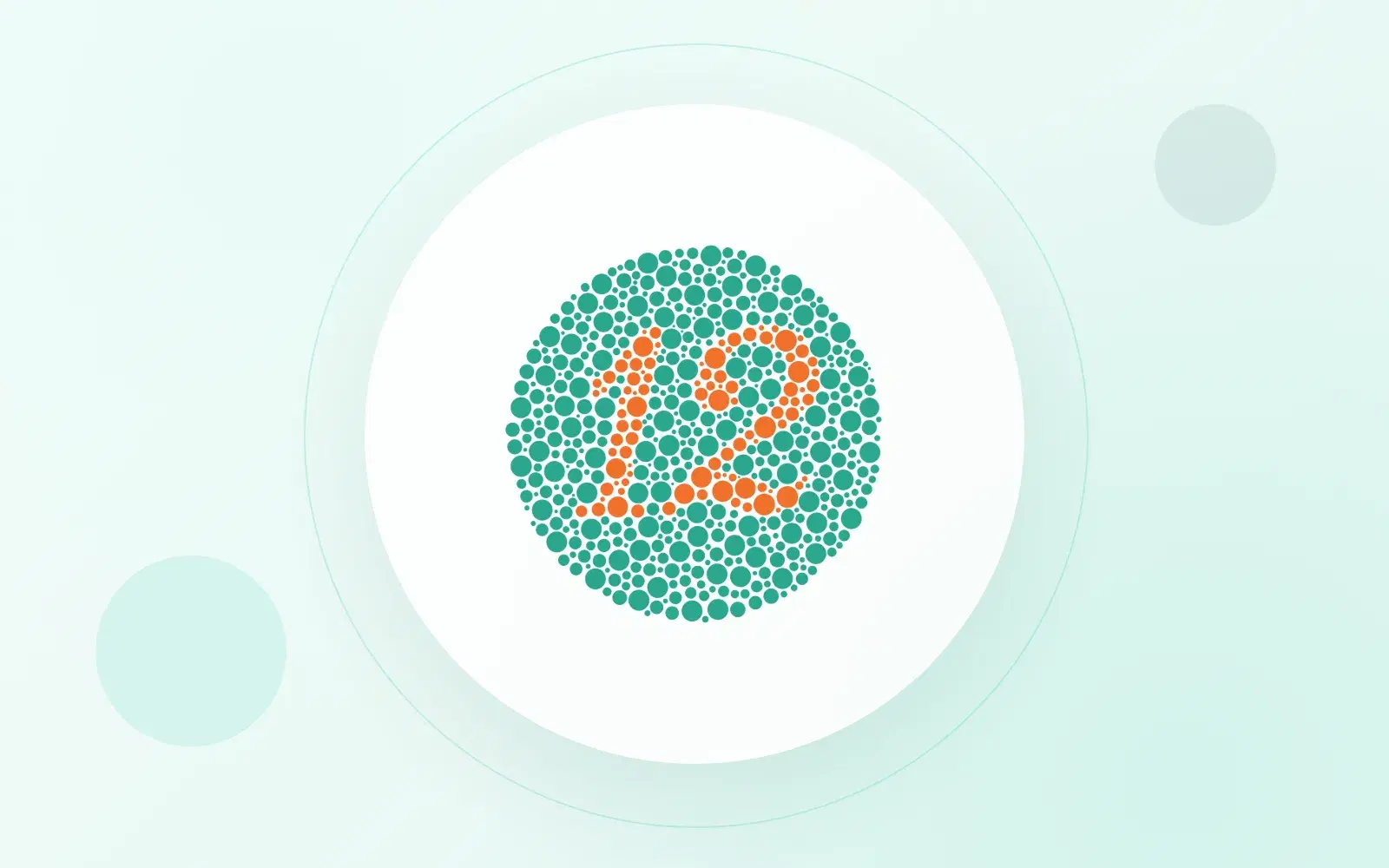
Colour vision lets the brain compare signals from different light-sensitive cells in the retina. Most people perceive a broad range of colours, but inherited or acquired differences can make certain shades harder to separate. The phrase colour vision deficiency is more accurate than assuming everyone affected sees only black and white.
The See the rainbow activity in Eye Care uses colour plates made from many dots. A number is formed by dots with colours that differ from the background. You keep both eyes open, hold the device at approximately arm's length and choose the number you can see. Similar plates are commonly used as one part of professional colour-vision testing.
Why a number appears—or disappears
The dots are arranged so that brightness and colour cues interact. For many viewers the number separates quickly from the background. For someone with a particular colour-perception difference, those groups of dots may look more alike, so the number blends in or a different pattern becomes noticeable. Different plates are designed to explore different colour relationships.
A plate is not a general intelligence or attention task. Guessing can create a misleading result, and memorising a familiar plate defeats its purpose. Select what you genuinely see and move on. A professional may use several plate sets or another method when the first result is unclear.
The phone display changes the test
Printed clinical plates are produced and viewed under specified conditions. A mobile display adds variables: colour calibration, True Tone or similar features, night modes, brightness, viewing angle, screen protectors and ambient light. Image compression and ageing displays can also shift colours. This means a phone activity can support awareness but cannot reproduce a controlled diagnostic test.
- Use neutral room lighting rather than strongly coloured lamps.
- Turn off night-shift or colour-filter settings before the check.
- Set the requested brightness and view the screen straight on.
- Keep both eyes open unless a qualified professional has told you otherwise.
- Do not rely on a screenshot shared to another device, because its colours may differ.
Inherited and acquired changes
Many colour-vision differences are inherited and remain relatively stable. A new change in colour perception, especially in one eye, deserves medical attention because it can have other causes. Medication, eye conditions and neurological problems may affect colour perception, so an unexpected new difficulty should not be explained by an app result alone.
A digital colour plate can raise a useful question. A qualified eye-care professional can determine whether there is a colour-vision deficiency and what type it may be.
When a formal result matters
Accurate colour discrimination can matter for some occupations, studies and safety tasks. The National Eye Institute notes that an eye doctor may use a colour plate test and, when needed, other methods such as hue-arrangement or light-matching tests. If you need documentation for work or education, use the assessment specified by the relevant organisation rather than a mobile self-check.
Talk with an eye-care professional if you repeatedly cannot identify the plates, if a child appears to confuse colours, or if your colour perception has changed. Seek prompt care when a colour change arrives suddenly or accompanies blur, pain or another new visual symptom. Eye Care can help you notice a pattern, but the next clinical decision belongs to a professional examination.
Living comfortably with colour differences
Many people with an inherited colour-vision deficiency adapt well, often without realising the difference for years. Simple strategies can reduce confusion in daily tasks. Labelling clothes or cables, relying on position as well as colour in traffic lights and charts, and asking for patterns or text labels in documents can all help. Many phones and computers also offer accessibility filters that adjust how colours are displayed. Designers and colleagues can help too, for example by adding labels, symbols or patterns to charts, maps and status indicators so that meaning never depends on colour alone.
These tools support everyday comfort, but they do not treat the underlying difference. Parents and teachers can also help by avoiding colour-only instructions in learning materials. If you are unsure whether a change is new, a professional assessment remains the reliable way to find out.